Thursday, October 2, 2008

Out of Africa-Namibian Sunset- 10


o We have left Namibia after a fabulous week, and are now in Cape Town, the last leg of this incredible journey. The change in temperature is dramatic, from very dry and hot in Namibia, to cool, rainy, and blustery here in Cape Town. During the course of our journey, we have done more than 60 hours of game drives. In many ways, the Namibian leg of our journey was the highlight of the entire African safari. The colours, the contrasts, the diversity and an infinite sense of space leaves one in a perpetual state of breathlessness. The colours, the space, and the silence are particularly powerful and magical.

o For both of us, Namibia was a life-altering experience. Our fantastic and experienced tour operator and guide, Andre Blaauw of Foxtrot Tours (with Eleanor, right), was our driver and a great travelling companion for the entire week and the 2500 kilometres we covered around the country. We never would have attempted the drive ourselves.......driving on the left, dealing with the bumpy, unpaved gravel roads (a great African massage!), locating the animals in their habitats, identifying the various birds and plants we saw en route, knowing where to find the points of interests in each area, and of course, knowing the great restaurants and being introduced to Namibian Tafel beer....the best beer in the world. He shared his incredible knowledge of Namibian wildlife, geography and insight into its indigenous peoples with us and his ability to speak the various languages certainly simplified every step of the trip. We travelled through arid desert, high mountain areas, Atlantic coastline, the dunes, and the cities. We visited a petrified forest and saw rock art made by the bushmen thousands of years ago. Thank you, Andre, for the experience of a lifetime. We WILL be back!

o One of the highlights of the trip was our assault of Dune 45, the most
frequently photographed sand dune in the world. It is 750 feet high- a beautiful windswept cone of reddish-brown sand with a 50-55 degree slope. The original plan was for both of us to climb it, but after a 15 minute slippery climb, Eleanor made the mistake of looking down. Far below, a toy bus was discharging tiny ant-sized tourists. At that point, she decided it was time to slide back down...slowly! Richard heartlesslessly waved goodbye, leaving her to descend alone while he carried on for another 45-60 minutes, and completed the 1 1/2 mile trek to the top. He says it was beautiful and well-worth the climb. Eleanor isn't convinced. The view from the ground was much safer! Below are two of the photos she took of him after she reached the bottom. In the first, he's the tiny speck rounding the curve at the centre of the photo. In the next one, he's a little further along that same curve.
o We were both overwhelmed by the colours of the Namib desert. Its hues range from a pale beige and pink, to a purple blue, to a dazzling rust. The tones and gradations of colour are infinite and change as the light changes. The Namib desert and Etosha pan are awe-inspiring. The complete and utter silence is incredible.
o In the bushveld it is said that every lodge is worth one pound of additional weight. Alas, it is true, and we visited over a dozen lodges. The meals have been fabulous and although we always meant to restrict ourselves to fruit for breakfast and a salad for lunch, one look at the other dishes offered was enough to make us change our minds. Richard says he feels 4 months pregnant. Eleanor is planning her shopping trip for size extra, extra, extra large. For the next few months, it'll have to be nothing but tuna and cottage cheese. Maybe.


o At Cape Cross, we visited a huge seal colony. 200,000-300,000 seals! The smell and the sound were unbelievable. Almost as far as we could see, there were black dots splashing and diving in the waves. On the shore, seals were sunning, barking, fighting, climbing over each other, and otherwise entertaining themselves, ignoring the tourists walking past. Definitely a sight worth seeing. Apparently, the herd grows even more during mating season in December, but this size was impressive enough.

o Windhoek and Swakopmund, the 2 Namibian cities we visited, were both modern, beautifully maintained cities, with a strong European atmosphere and a great deal of German-inspired architecture. We'd love to return and spend a warm winter vacation here.

o Every country has a hidden history and Namibia is no exception. The 1904 German-Herero-Nam War resulted in the extermination of 2/3 of the Herero tribe, when they were driven into the Kalahari desert to die of thirst. The 1985 UN Whitaker Report called the Herero genicide by the Germans the first genocide of the 20th century.

o SWAPO, the liberation movement which subsequently came to power in 1990, seems directionless in terms of its economic development strategy, notwithstanding the generous royalty cut from various mineral companies. A thin and uneven distribution of population, compounded by arid terrain and a severe shortage of fresh water, retards economic and social programming.

o Economic facts: Namibia has an unemployment rate of 35%, not counting those who have chosen to live in their traditional tribal ways; inflation is at 11% and a housing mortgage is 15.5%.
o Social services, especially public education and medical care, seem to have a bad reputation, but the U/Namibia in Windhoek, with a student population of about 15,000, seems modern and well-cared for, much like Trent U. In reality, there is a 2-track delivery system for education and health care: private services for those who can afford it (mostly whites) and public for those (mostly Black) who can't.

o Demographically, the population is 90% black and Catholic; 10% are white Dutch Reform or other protestant denominations. As well, there seems to be a small, fairly high profile and prosperous Jewish community.

o This will be our last blog from Africa. Here in Cape Town we plan some R&R- a city tour and an all-day wine tour. Strange, maybe, that we need R&R after a month-long holiday, but there have been so many new experiences and sights that we'll need some time to digest all we've seen and mull things over.

o On our return we hope to post some of our photos and add a final installment summarizing our feelings and conclusions about our African Odyssey.

Richard and Eleanor

Sunday, September 28, 2008

Out of Africa- God's Country, Namibia-9


- We have now been in Namibia for the past 4 days. It is absolutely gorgeous and enchanting! By the time we're done, we'll have travelled 2500 km, north to south. 6 months ago, we'd hardly heard of this place; now we love it.
- Namibia is blessed with 217 minerals, 10 of which are only found here. The population is just under 4 million people, with only about 2 people per kilometre, and it has the highest per capital income in the world. Richard maintains that the tall grass is coloured a Van Gough yellow and the sunsets look like a Monet purple and pink.

- We arrived in Windhoek, the capital city, and were very surprised by its modernity and its German flavour. No dusty cowboy town with tumbleweed, the way we'd half expected.

- The food throughout the trip has been great, often haute cuisine. Eleanor isn't as upset about this as Richard is; she's looking forward to shopping for new clothes when she gets home....if she can fit on the plane to get home! We've tasted mixed game grills, including Kudu in mustard sauce and grilled oryx, which is very tender. We've tried warthog, crocodile, ostrich, and other delicacies. Richard maintains that Namibian Taffel beer and Zimbabwe blue cheese are the best he's tasted. We should say that the game meals were ordered by choice. There's always plenty of the more familiar meats available, but when in Rome.....

- We visited Etosha National Park, which is half the size of Switzerland, where we had some of the best game-viewing yet. The Etosha salt pan is about 25% of the park and is 90 km across. It is so visually stunning, it's hard to describe. The greenish-gray mineral soil blends with the horizon as far as the eye can see. It truly gives one a visual sense of infinity.

- We stayed at a lodge with a floodlit waterhole, with seats surrounding the protective wall so we could sit and watch the action any time, day or night. It's better than a play! At some unseen signal, guinea fowl ran down the hill from a directions, splashed around, and then disappeared again. Herds of zebras and antelopes appear on cue. The animals on the right are mongeese (mongooses?). It was our only sighting of these renowned snake-killing animals, and we were surprised to see how small they are.
When the ellies arrive at the waterhole, the others have to leave. They drink alone, thank you very much, and there aren't too many animals that would dare to challenge that right. One trumpet call from the leader and the other animals scatter. Usually, anyhow. The night we were there, a mother black rhino and her baby got tired of waiting for the ellies to finish. Very slowly, she strolled to the pool. At first, most of the elephants simply looked shocked. Then one of those trouble-making teenage males decided to prove his manliness and walked over to her, ears out and trunk raised to make him look big and fierce. She took one step towards him and he ran off to join his friends. For a while it looked as if a few of the other young males might join forces to run her off, but just like in the movies, reinforcements arrived; 3 other adult rhinos and two babies showed up to balance things a little, and the ellies decided it was time to cut their losses and move on to let the rhinos enjoy the water in peace. Since our cameras aren't really designed for night photography, the photo here isn't great, but it does show mama rhino teaching junior how to stand up to a bully.
- Right now, we've crossed the Namib desert and are at Swakopmund on the Atlantic coast, which is like being on a Maritime beach. The Altantic coast here is the famous Skeleton Coast, so-named because of the many humans and animals that have died of thirst in the region. It's beautiful, but very sparsely populated because there's very little fresh water to be found. We're staying at the aptly named Stiltz hotel. Tomorrow we head off for the famous Namibian sand dunes, where we'll try to climb the famous Dune 45. Wish us luck!

- This will probably be our last blog entry until we arrive in Cape Town on October 2. Best to all.

Out of Africa- Close Encounters of a Dumbo Kind (Cont'd)-8


Richard and Roger's first adventure with the elephants first occurred when they were walking from the savannah into a shady, wooded area and found themselves within 30 metres of a well-camouflaged ellie (I hate that name!). Roger grabbed Richard's shoulder, pushed him, and yelled, "Run!". Run they did, pulling back about 100 m until the elephant lost interest and moved on in search of a tastier tree.

The sun sets quickly here, so at 6 PM, it's time to head back to the mokoro to get back to camp before the hippos come out at dark, but heading back to the river at 5:45 PM, they found a father/son elephant team blocking their way to the river. Roger wasn't worried about the old guy but said that teenage males are very unpredictable (where have I heard that before?) and could easily kill them. They stood in the tall grass with the sun blazing down in 38 C temperatures for an hour. Then the ellies began to move down the hill towards them, reducing the distance between them and the men from about 100 m to a frightening 70 m. Richard and Roger then decided it was time for a strategic retreat back into the darkening bush and made an end run to the right to outflank the ellies and get back to the boat, but the ellies walked back up the hill and trapped them again.

Guides in the Okavango don't carry guns ( a policy Richard now takes STRONG exception to!). Roger had a walkie-talkie to connect him with the camp and carried a cigar-sized flair that creates a loud noise and a lot of smoke to scare off most animals. He armed the flare and contacted camp. One of the other guides went over to the island by motorboat and distracted the ellies to give Richard and Roger time to get to the mokoro.

The following afternoon, as a farewell gesture , I'm sure, an elephant was dining on the tree outside our platform tent when we returned from lunch. When he showed no sign of leaving, we had to get staff, who chased him a way after considerable effort and risk.

We left the camp shortly afterwards, and although I'd dreaded the tiny plane when we arrived, I welcomed the trip out of the bush and delta, away from the excitement of all those critters. Funny how a couple of days can change your outlook!

We've now arrived in Namibia. New blog to follow.

Wednesday, September 24, 2008

Out of Africa-Close Encounters of the Elephant Kind- 7

They say that if you want to stay young, it's important to step outside your comfort zone once in a while. If that's true, then after the past 3 days, Eleanor's age really is the 39 she's been claiming for the last 20 years.


From the time we began planning this trip, the idea of flying in an aircraft smaller than a Smart Car has made her nervous, so when we arrived at Kasane Airport for our flight to Gunn's Antelope Camp in the Okavanga Delta, Botswana, she was relieved to learn that instead of taking the 6-seater we had been expecting, we'd be flying in a larger, 12-seater plane instead.

The relief was short-lived. Our plane landed on a tiny airstrip in the middle of nowhere. There were no buildings; 3 Landrovers and a Smart Plane were there to greet us. You guessed it: the Landrovers were for the other passengers. We climbed into the 6-seater plane and met the pilot, who looked to be about 16. Co-pilot Rick volunteered to sit beside him and spent the 20-minute flight with a huge grin on his face, asking about all the dials and screens while Eleanor sat at the back with fingers and eyes crossed, praying that such a small plane would be able to stay in the air long enough to get us over the croc and hippo-infested water just a few metres below.


By some miracle, we made it to Gunn's tiny airstrip, where we were met by our guides/polers who were to take us to the camp. Surprise! Our new mode of transportation was a mokoro, a flat-bottomed dugout canoe-type boat that holds two passengers and a poler, who stands at the back and uses a long pole to push the boat through narrow channels cut into the 2-3 foot high hippo grass growing in those same dangerous waters we had seen from the air.

Definitely out of her comfort zone at this point, Eleanor was a little reassured to learn that our poler, Roger, had been doing this job for 15 years, and since he still seemed to have all his limbs he obviously had acquired the knack of avoiding the dangerous creatures lurking just beneath the surface as he poled. He pointed out the varieties of birds and water lilies as we passed and even created a water-lily necklace especially for her. Although she finally relaxed a little and now acknowledges that the 20-minute mokoro ride to the camp was beautiful and certainly cooled us off nicely, it was definitely not her most relaxing experience on this trip.


When she had nearly stopped shaking, she asked Roger about the risk level of water travel on the river. He assured us that the narrower channels we were using were too shallow for the big crocs and hippos. At that point, we crossed a much wider channel. He pointed down the channel with his pole. "That's the hippo highway," he said. As we crossed safely to the narrow channel again, we couldn't help wondering if the the hippos and crocs understood the lines of demarkation as clearly as Roger did. One nugget of information we had collected as we planned our trip: hippos kill more people in Africa each year than all the Big 5 combined. We wondered how many of these people were polers who made a mistake.

When we landed, Eleanor was tempted to kiss the ground. It's a good thing she didn't! As we learned during the briefing session we receieved before they showed us to our tent, the area has poisonous spiders, poisonous snakes, and scorpions. We were told to stick to the dirt paths that are raked regularly and to look down while walking. Oh! And look up, too, since the black mamba snake can drop from trees. Meanwhile, be sure to look straight ahead, too, to watch for the elephants who hang around the camp. They don't appreciate guests bumping into them while watching for snakes. Then we had to sign a liability form acknowledging that we were aware of the deadly wildlife but were crazy enough to stay anyhow...or something to that effect.

Gunn's is a real bush camp, with tents on platforms overlooking the river. Safely zipped into our tents for the night, we actually enjoyed the evening symphony: frogs and birds chirping, fish and crocs splashing, hippos grunting, elephants trumpeting, wild dogs barking, lions roaring...believe it or not, it's a nice music to fall asleep to, as long as the loudest noises are the furthest away.

There are no game drives at Gunn's; there are bush walks instead. At 7 each morning and 4 each afternoon, we made our way across the hippo highway by mokoro to Chief's Island, a game reserve on the other side of the river. Question: if we had to keep to the paths at camp, was it safe to walk around on the island for 3 hours? "No problem" said Roger. "Just follow me". So we literally followed in his footsteps as we tramped through swamps and forests hunting for the animals and hoping they weren't hunting for us.

To be honest, it was a great experience. Roger could read the tracks the way we can read a book. Like a good teacher, he'd point out tracks, ask what we thought they might be, correct us the many times we were wrong, and later when we came across the same tracks, he'd test us to see if we remembered the lesson. He told us how to escape if dangerous animals came too close. Ellies: run in a zigzag direction. Buffalo: climb a tree or play dead. Lion and leopard: don't run, don't make eye contact, walk backwards slowly.

The risk of coming face to face with these animals was a little overwhelming for Eleanor. That and the 40 C temperatures led her to the decision to skip the afternoon walks and let Ranger Rick and Roger handle them alone. She'd like to claim psychic powers and say that she foresaw Richard's two deadly afternoon encounters with elephants, but the truth is, she was lazy. The pool and a good book were more attractive than tramping through the bush looking for trouble.

Next time we'll tell you about how he faced down the elephants . Stay tuned!

Right now we're in a very civilized inn in Windhoek, Namibia, the Olive Grove guest house. Check out Windhoek on the internet. It's a beautiful, modern town in the middle of the desert.
Off to Etosha and more elephant encounters in the morning, but meanwhile, we'll be sleeping in a real room in a real town!

Saturday, September 20, 2008

Out of Africa- At the waterhole- 6

o We've now moved on to Botswana, a small country of about 1.7 million people. Botswana and Namibia are both very prosperous resource-based economies based on copper and diamonds. Botswana, like the UAE, has been able to introduce a very successful trickle-down economic strategy. They have among the highest per capita income in the world, but the rural areas have much in common with SE Cuba.

o We are staying at Elephant Valley Lodge at the Chobe National Park. The weather here is 36 C in the shade and considerably more in the sun. The name of the lodge is appropriate. There are herds and herds of elephants....a regular elephant convention.

o To say that we are roughing it in the bush would be a slight exaggeration. The lodge itself is embarrassingly luxurious (check the link to see photos). We are in platform tents, 20x40 feet, with electricity, running water, hot showers, flush toilets, and even an electric blanket for Richard, which he seems to find necessary because the temperature drops to between 10 and 15 C at night. Alas, there is no mini bar. The food is great, including warthog steaks and mealie-pap. We know a couple of vegetarians who might argue that it's a little uncharitable to photograph the animals by day and eat them at night, but warthogs taste much more agreeable than they look...trust us!


o Our tent overlooks the watering hole, where there is a constant parade of animals. Throughout the night, there is a symphony of sounds from the animals and birds. The politics of the waterhole seems to be much more complicated than is ordinarily appreciated- it is both ruthlessly competitive and cautiously commutarian.

o But for us, the big rush- the ultimate thrill- came in the late afternoon game drive yesterday when we came upon 3 young (4-year old) lioness sisters basking in the sun. We were able to get within 17 feet of them. They weigh about 350 lb and were about 7 feet long, with paws about 8 inches in diameter. They were solid, barrel-chested, and obviously well-fed. When they looked at us imperiously, we worried that we might be on the night's menu, but they had feasted on water buck that morning and luckily, weren't in the mood for a snack. They exuded raw power, elegance, and confidence. This is primordial nature at its best!


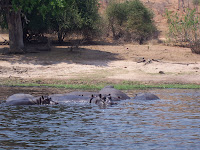
o This morning we took a sunrise boatride on the Chobe river. For the first time, we saw crocodiles and huge herds of hippos, along with the mandatory elephants, but this time, instead of destroying the trees in the bush, the elephants were eating water grass and were swimming, splashing, and otherwise enjoying the river. It came as a surprise to us to hear that hippos don't swim. Usually, they try to stay at a depth that allows them to keep their feet on the bottom and their heads above water. If they find themselves over their heads, they walk along the bottom to a more shallow area. Elephants, though, are great swimmers. We watched large herds swim in single file to the island in the centre of the river to enjoy the thick grass that was growing there.


One sight we enjoyed: when the elephants finish swimming, spraying, bathing and drinking in the water, they go through the complicated ritual of getting dirty again. They fling trunks full of sand or mud over themselves, creating a mudpack that dries on their skin and protects them from both the sun and the parasites. Nearly every place we've visited in Africa so far, the grays of the elephants have seemed to differ in shade, but the difference is really due to the colour of the soil they use, which ranges from almost white to a vivid deep red.


o Tomorrow morning we take a small plane to Gunn's Camp in the Okavango Delta for 3 days. It's unlikely that there'll be internet access...and Richard is worried that there may not be electric blankets, either. This will REALLY be roughing it!

Out of Africa- The reality on the ground- 5

o We were in Zim at Victoria Falls on September 18 and 19. The falls are awesome- the raw energy and power is beautiful. The mist creates a beautiful rain forest and the view borders on the spiritual.

o We arrived in Zim 2 days after the new power-sharing agreement was negotiated. Many people greeted us by saying, "Welcome to the New Zimbabwe!" [Since our return, 3 different versions of the agreed-upon power sharing agreement have been discarded by Mugabe, and civil peace seems no closer today than it was before our trip.]

o Vic Falls, notwithstanding its beauty, is solely for tourists, but the tourists aren't coming; it's like a ghost town. Even the local casino was empty and we were only one of 3 couples in the magnificent teak hotel dining room, built to accommodate about 200 people.

o In brief, Zim is grim. It puts a new meaning to the term "economic undervelopment". But then, few have really cared about strategies for economic development since the end of the Cold War. Things are so bad here that people are killing elephants for the meat rather than for the tusks, which are worth $10,000-12,000 US each.

o In the old colonial Rhodesia, railway ties were made of teak and farms were lush. Times have changed. Ironically, people in Zambia and Botswana often send their children to elementary school in Vic Falls despite the problems.

o The people are friendly and decent but the level of poverty and beggary are overwhelming and appalling.

o The people who welcomed us to the New Zim are cautiously optimistic. There are good reasons to be sceptical about their optimism. As one person told us, "The only thing we have is hope". Zimbabwe truly is a beautiful country, and we can only hope that the political situation improves soon, and the tourists are able to return to enjoy the area as much as we did.

o After 2 weeks on the road and living out of our suitcases, we are beginning to feel tired of being perpetually on the go! Still we enjoy all we are seeing and have no desire to cut the trip short. Now we are in Botswana, home of Mma Ramotswe and redbush tea, for those who've read the #1 Ladies Detective Agency books. Haven't seen Mma yet, but we enjoy the redbush tea.