They say that if you want to stay young, it's important to step outside your comfort zone once in a while. If that's true, then after the past 3 days, Eleanor's age really is the 39 she's been claiming for the last 20 years.

From the time we began planning this trip, the idea of flying in an aircraft smaller than a Smart Car has made her nervous, so when we arrived at Kasane Airport for our flight to Gunn's Antelope Camp in the Okavanga Delta, Botswana, she was relieved to learn
that instead of taking the 6-seater we had been expecting, we'd be flying in a larger, 12-seater plane instead.


The relief was short-lived. Our plane landed
on a tiny airstrip in the middle of nowhere. There were no buildings; 3 Landrovers and a Smart Plane were there to greet us. You guessed it: the Landrovers were for the other passengers. We climbed into the 6-seater plane and met the pilot, who looked to be about 16. Co-

pilot Rick volunteered to sit beside him and spent the 20-minute flight with a huge grin on his face, asking about all the dials and screens while Eleanor sat at the back with fingers and eyes crossed, praying that such a small plane would be able to stay in the air long enough to get us over the croc and hippo-infested water just a few metres below.


By some miracle, we made it to Gunn's tiny airstrip, where we were met by our guides/polers who were to take us to the camp. Surprise! Our new mode of transportation was a mokoro, a flat-bottomed dugout canoe-type boat that holds two passengers and a poler, who stands at the back and uses a long pole to push the boat through narrow channels cut into the 2-3 foot high hippo grass growing in those same dangerous waters we had seen from the air.

Definitely out of her comfort zone at this point, Eleanor was a little reassured to learn that our poler, Roger, had been doing this job for 15 years, and since he still seemed to have all his limbs he obviously had acquired the knack of avoiding the dangerous creatures lurking just beneath the surface as he poled. He pointed out the varieties of birds and water lilies as we passed and even created a water-lily necklace especially for her. Although she finally relaxed a little and now acknowledges that the 20-minute

mokoro ride to the camp was beautiful and certainly cooled us off nicely, it was definitely not her most relaxing experience on this trip.
When she had nearly stopped shaking, she asked Roger about the risk level of water travel on the river.

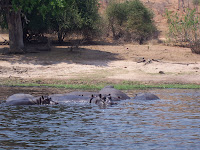
He assured us that the narrower channels we were using were too shallow for the big crocs and hippos. At that point, we crossed a much wider channel. He pointed down the channel with his pole. "That's the hippo highway," he said. As we crossed safely to the narrow channel again, we couldn't help wondering if the the hippos and crocs understood the lines of demarkation as clearly as Roger did. One nugget of information we had collected as we planned our trip: hippos kill more people in Africa each year than all the Big 5 combined. We wondered how many of these people were polers who made a mistake.
When we landed, Eleanor was tempted to kiss the ground. It's a good thing she didn't! As we learned during the briefing session we receieved before they showed us to our tent, the area has poisonous spiders, poisonous snakes, and scorpions. We were told to stick to the dirt paths that are raked regularly and to look down while walking. Oh! And look up, too, since the black mamba snake can drop from trees. Meanwhile, be sure to look straight ahead, too, to watch for the elephants who hang around the camp. They don't appreciate guests bumping into them while watching for snakes. Then we had to sign a liability form acknowledging that we were aware of the deadly wildlife but were crazy enough to stay anyhow...or something to that effect.

Gunn's is a real bush camp, with tents on platforms overlooking the river. Safely zipped into our tents for the night, we actually enjoyed the evening symphony: frogs and birds chirping, fish and crocs splashing, hippos grunting, elephants trumpeting, wild dogs barking, lions roaring...believe it or not, it's a nice music to fall asleep to, as long as the loudest noises are the furthest away.
There are no game drives at Gunn's; there are bush walks instead. At 7 each morning and 4 each afternoon, we made our way across the hippo highway by mokoro to Chief's Island, a game reserve on the other side of the river. Question: if we had to keep to the paths at camp, was it safe to walk around on the island for 3 hours? "No problem" said Roger. "Just follow me". So we literally followed in his footsteps as we tramped through swamps and forests hunting for the animals and hoping they weren't hunting for us.
To be honest, it was a great experience. Roger could read the tracks the way we can read a book. Like a good teacher, he'd point out tracks, ask what we thought they might be, correct us the many times we were wrong, and later when we came across the same tracks, he'd test us to see if we remembered the lesson. He told us how to escape if dangerous animals came too close. Ellies: run in a zigzag direction. Buffalo: climb a tree or play dead. Lion and leopard: don't run, don't make eye contact, walk backwards slowly.
The risk of coming face to face with these animals was a little overwhelming for Eleanor. That and the 40 C temperatures led her to the decision to skip the afternoon walks and let Ranger Rick and Roger handle them alone. She'd like to claim psychic powers and say that she foresaw Richard's two deadly afternoon encounters with elephants, but the truth is, she was lazy. The pool and a good book were more attractive than tramping through the bush looking for trouble.
Next time we'll tell you about how he faced down the elephants . Stay tuned!
Right now we're in a very civilized inn in Windhoek, Namibia, the Olive Grove guest house. Check out Windhoek on the internet. It's a beautiful, modern town in the middle of the desert.
Off to Etosha and more elephant encounters in the morning, but meanwhile, we'll be sleeping in a real room in a real town!
 Richard and Roger's first adventure with the elephants first occurred when they were walking from the savannah into a shady, wooded area and found themselves within 30 metres of a well-camouflaged ellie (I hate that name!). Roger grabbed Richard's shoulder, pushed him, and yelled, "Run!". Run they did, pulling back about 100 m until the elephant lost interest and moved on in search of a tastier tree.
  efore?) and could easily kill them. They stood in the tall grass with the sun blazing down in 38 C temperatures for an hour. Then the ellies began to move down the hill towards them, reducing the distance between them and the men from about 100 m to a frightening 70 m. Richard and Roger then decided it was time for a strategic retreat back into the darkening bush and made an end run to the right to outflank the ellies and get back to the boat, but the ellies walked back up the hill and trapped them again.
 and delta, away from the excitement of all those critters. Funny how a couple of days can change your outlook!




 o 3 days ago, we left the luxurious Kuname Lodge and Game Reserve near Kruger National Park. It was a marvellous experience- see our link to the lodge as well as our comments below. We then returned to Jo'burg for the night and moved on to Victoria Falls in Zimbabwe. Throughout our stays at a number of game lodges, it is easy to focus only on the Big 5, but we've been surprised and impressed by a number of other things:


 o This male lion is called Zero by the rangers. He is 14 years old, weighs


