Friday, September 19, 2008

Out of Africa- Sex and the Savannah- 4

o 3 days ago, we left the luxurious Kuname Lodge and Game Reserve near Kruger National Park. It was a marvellous experience- see our link to the lodge as well as our comments below. We then returned to Jo'burg for the night and moved on to Victoria Falls in Zimbabwe. Throughout our stays at a number of game lodges, it is easy to focus only on the Big 5, but we've been surprised and impressed by a number of other things:

o Within South Africa, our travels have taken us from the savannah, or bushveld, to the lowveld; that is, going from grassland to land similar to Gatineau Park. At Kuname Lodge, we were facing the Drakenburg Mountain range, with its gray, cobalt blue and red stratified colours. We're both fascinated by the extremely varied and colourful bird life. The birds' colours do not attract predators, because animals' colour perception is different from ours; one can understand how Europeans became enthralled with Africa as a result of its physical beauty.

o The game viewing at Kuname was magnificent, and was only surpassed by the cordiality and hospitality of Linda, Christine and their staff and the fabulous food. And yes, we even stop for "sundowners" (cocktails) during the evening game drives; we have even become accustomed to being woken at 5 AM for the morning game drives.

o IT MUST BE EMPHASIZED THAT THROUGHOUT OUR TRIP, WE GO WITHIN 15-20 FEET OF VIRTUALLY ALL THE ANIMALS, INCLUDING THE BIG 5, EVEN THE LIONS AND CHEETAHS; AND LAST NIGHT, WITHIN 2 METERS OF A BLACK RHINO.


o Without a doubt the most awesome experience at Kuname was coming across a copulating lion couple. We were withing 15 feet of them, but they were otherwise occupied and didn't seem to mind our presence. A female lion in estris will copulate 150 times in a 4-day period. Afterwards, both lions rolled over, panting and satiated....for the moment, at least.
o This male lion is called Zero by the rangers. He is 14 years old, weighs about 400 pounds and is about 6-7 feet long. Nice Kitty..... The rein of an alpha male lion is short- only about 1 year. He is fed and serviced by the females and is thus weakened so that a younger, fitter male can easily take over the pride. But what a way to go! In this photo, we purposely included the vehicle in the picture of Zero to show how close we were able to get. The animals are conditioned to the presence of the vehicles, so as long as everyone remains seated and stays quiet, the animals aren't overly concerned with our presence.


o We also experienced many other firsts with our superlative guide, Rian. We saw our first hippos, crocs, and cheetah. Rian always brought something new and insightful to our game drives.


o One of the highlights at Kuname was on our last morning drive. We walked within 30 feet of a mother cheetah and her 3 cubbies. The mother watched us in a blase, bored manner. The babies were all fluffy....like kittens.


o After we left Kuname, we took the Blyde River Canyon route back to Jo'burg. It is called the Panoramic route for good reason. It is where the Blood and Blyde Rivers meet and the canyon has been carved out by the water to look like modern sculpture. Beautiful!


o After a night in Jo'burg, we flew to Victoria Falls in Zimbabwe (Zim) which is an entirely different world. We'll comment more in our next posting.

Monday, September 15, 2008

Out of Africa- Eleanor and Richard up in a tree-3


o We stayed overnight at the Pezulu Treetop Lodge, a unique and luxurious experience!


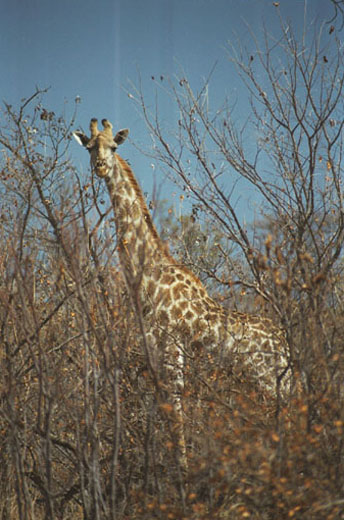
o The view from the veranda of the savannah was tranquil, with a low sky and seemingly endless hay-coloured tall savannah grass, and the occasional tree. The first time we climbed the ramp to our house, about 25 feet off the ground, we were able to see 2 giraffes having lunch on the tree opposite, as well as 2 impalas who were sitting below waiting for the birds to drop the merula fruit.


o We went on one game drive. The park is highly populated with about 30 varieties of larger and smaller antelopes, ranging from the tiny dik-dik to the large magnificent elands; there are, nominally, no predators here. We saw the occasional giraffe, zebra, rhino, and had our first sighting of kudu and a small herd of Blue Wildebeest.

o Walking back to our tree house after dinner at the lodge, we were startled to hear the roar of a lion, since we'd been assured there were no predators on the property. That evening in bed, we heard the roar of a lion in the distance several times. The next morning, the owners told us that the property next door did have lions, and that's what we'd heard. Stupidly, Eleanor asked if the lions ever escaped the other reserve. "Yes, occasionally. In fact, we found 2 of them near here a couple of months ago." Gulp.

o In honour of our visit to Pezulu and given that we found a skink (small lizard) enjoying the dripping tap in the copper sink in our bathroom, Eleanor has composed the following ode to commemorate the experience. Move over, Dr. Seuss!

There's a Skink in our Sink

Rockabye baby, high in a tree,
We're in a cabin, snug as can be.
Hot and cold water, comfortable bed,
Mosquito net canopy draped overhead.

The bathroom is up one more branch on our right,
It's lovely by day but a cold trek at night.
A shower, flush toilets, a large copper sink
That we share with a lizard-like thing called a skink.

The tree is alive- a merula, we're told,
30 feet tall and it looks very old.
Birds love its fruit so they come and they go,
Small antelope eat what they drop, far below.

Sit on the deck, watch the wildlife pass by;
Giraffes come so close that we meet eye-to-eye.
At dark, the full moon paints it silvery bright
And the roars of the animals ring through the night.


The brown-hued savannah, the bright-coloured birds,
The soft-filtered light--how can I find the words
To describe all the wonders we saw from our tree?
It's a brand new perspective for Richard and me!


o We are now at the Kuname private game reserve, where we caught a lion couple at a very intimate moment, and who almost looked cute in their post-coital repose. But more about Kuname in our next report. Stay tuned......

Saturday, September 13, 2008

Out of Africa- That Rhino is a stone! -2

Jambo!

o In Jo'burg, we visited the Old Fort prison complex on Constitution Square. Mandela was imprisoned here before being sent to Robben Island. The place was sufficiently depressing to confirm our view that prisons aren't nice places, especially if you're Black and living in S.A.


The new Supreme Constitutional Court building is architecturally interesting. Canada and SA now have many judicial similarities, especially in the human rights field. SA has come a long way in the 14 years since the Apartheid era. One fact that we found fascinating: South Africa has 11 official languages. Imagine how that would complicate matters here in Canada, where we sometimes have trouble with 2 languages on a sign!

0 Jo'burg is a large city of 11 million people. We aren't sure what we expected, perhaps a small town with thatched huts, but in reality it is a modern and urbane city in the process of urban renewal. Its streets are broad and clean. It is home to 5 large universities, but still has a real and ugly crime problem.

oThis time of year, the savannah here in Kruger Park is like being at Ground Zero after a nuclear blast or a forest after a fire. This is a result of elephant damage as they eat and destroy all foliage and bark. Regrettably, 5,000 of the 12,000 elephants in Kruger must be culled this year because the park can't sustain them in larger numbers.

o The weather is unseasonably cold, + 8 C at night, but a welcome relief from the 43 C they had earlier this week. It's spring here, the rainy season hasn't started yet, and trees are bare and grass is brown. All the guide books warned us of the cold, but hey! We're Canadians! How bad could it be? We found out the hard way. After freezing on the first drive, we dug all of our warm sweaters and jackets out of our suitcases and got into the habit of layering them before venturing out on the early morning drives.


o We were lucky at our first full day at Umlani Lodge near Kruger. After getting up at 5 AM for our first game drive, we saw 4 of the Big 5. We've seen over 30 elephants (they often come on to the property and drink from the pool, just a few metres from the bar), including a very young calf with its umbilical cord still attached. They told us he was just a day or two old.

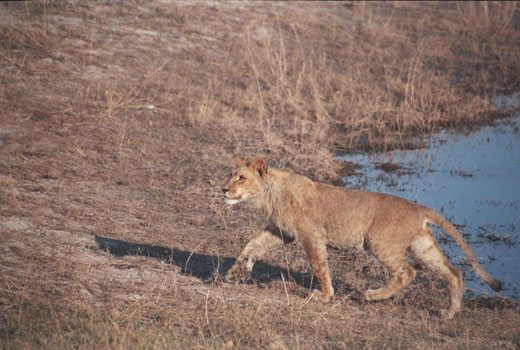
On our very first evening drive, we saw a young and deceptively passive 4-year old light coloured lioness. Here at Timbavati Reserve, they have been known to have white lions similar to the ones usually found in Tsavo in SW Kenya. Since it was almost dark at the time, the photo isn't as clear as most, but we decided she still deserved a place in our blog.


We saw 4 white rhinos at Umlani, as well, but the star sighting was a sleek female leopard sitting in a tree with her previous night's kill- an impala. On our evening game drive she was still there, but had brought her 7-month old cub to share the feast. On the savannah impalas are called "MacDonald's" for 2 reasons: they have an "M" shaped marking near their tails, and they're easy meals.

o We're learning to recognize the scat of the different animals: large brown turds for "ellies", black patties for rhinos, and white for hyenas; if there is grass in the rhino droppings, it's a sure sign of a white rhino, not a black one.

o We were lucky to spot 2 ferocious honey badgers, which look like skunks without tails. While usually very docile, they won't hesitate to take on a lion or kill hyenas. We've seen zebras and loads of giraffes and have been able to identify 4 out of their 8 markings.

o We're struck by the incredible diversity and colour of the flora and birds; a true birders' paradise. The perpetual background noises are incredible- and a little scary sometimes, especially at night. We've come to appreciate the idea of an eco-system.

o Flash- on our last morning game drive we spotted and drove through this herd of about 300 Cape buffalo, considered to be the most dangerous big game animal. Luckily for us, they ignored our presence. We also saw lion tracks but no lions.


The two leopards were still in their tree with the remains of the poor impala, and two hyenas waited below for the leftovers.


o A last word about Umlani Lodge: the proprietor, Dale, his sister, Michelle, and their team are first-rate and have a strong conservationist outlook. The food is hardy and delicious with homemade muffins and breads and a wonderful menu. The rangers and trackers are absolutely great and their knowledge seems boundless; they happily answer every question and their ability to track and spot game is uncanny. We noted that their open 4x4 Landrover is equipped with a .458 rifle, large enough to stop anything on 4 feet, but luckily they didn't need to use it while we were there.

o We are now at Pezulu Lodge on another game reserve, staying in a tree-top house. You can see photos on the Pezulu link. We'll keep you advised...

Friday, September 12, 2008

On the Ground in Africa-1

Greetings from Africa!

So much for our great plans of writing every day even if we had to use Bush Telegraph. Our last hotel assured us they had internet access, but we found out that we needed to provide our own computer. Doh!

After a gruelling and brutal 27 hour trip we landed in Johannesburg. We stayed at Aloe Ridge hotel, on the northern edge of Jo'burg. It's a beautiful, well-tended, and quiet place, sloping into the African countryside- the perfect spot to adjust to time differences and recover from jetlag. We're beginning to realize that there might be a few other differences we'll have to adjust to, as well:

What immediately strikes us is the quality of the light: a gentle pale Vermeer white that reminds us of the light in Tuscany. Our first full day there, it was 28 C, a lovely temperature for us, but cool for here since it's early spring. Locals walk around in quilted jackets and wool touques.

A few experiences stand out from our first 2 days on the ground:

o Having breakfast on our first day, we saw 2 black flashes streaking past the pool. They were baboons (or Gabes, as they're called here) out for their daily run. Later, we saw one of them by the main entrance, waiting paitiently for a waiter, who feeds him every day. At almost the same time a herd (gaggle? squadron?) of 5 zebras stopped for a drink at the pool and stood for a while under the thatched umrellas for shade.

o That evening we had a fabulous haute cuisine meal with a delighful S.A. wine at a "Astronomy and Gastronomy" presentation in the hotel's Conservatory restaurant. The owner, Alex Richter, has a 1.5 ton telescope, the 2nd largest amateur telescope in the world, in a library adjoining the restaurant. He clearly runs Aloe Ridge to finance his passions in animals and astronomy. Throughout the meal, guests watched a light show based on Hubbel telescope photographs, and between courses were invited to look through the telescope, as Richard is doing in this photo. Fabulous!

o The next day we had a private daylight tour of Jo'burg, a city of 11 million people, and despite its rough reputation, is modern and urbane.

o Yesterday, we left for Kruger National Park. Now we're at Umlani Lodge. Check it out on our link. What a fabulous place! We've already been on 2 game runs and seen 4 of the Big 5. More later.........

Friday, August 29, 2008

Time to Pack

Eleanor says:

After a year of planning and researching this trip, we’re almost ready to go.

We’ve had our travel shots and bought our meds, which cost us a small fortune since our medical plans don’t cover them. Now we have the required documentation to assure the wild animals we meet that we’re fresh, Grade A certified, well-tenderized, and disease free Canadian meat. Comforting thought.

Richard has read everything there is to read about the history and the political structure of the entire African continent, and although I think he’s been slacking a little when it comes to bird, snake, and insect life, he’s read up on the animals we’ll see on safari. He’s shamed me into learning which animals are included in “The Big Five” (B.R.E.L.L.: water Buffalo, Rhino, Elephant, Lion, and Leopard) but I’m woefully ignorant about some of the other important animal facts he feels are necessary for this trip.

For example, did you know that lions are very efficient predators? They sleep 18 hours a day and hunt and socialize for only 6, compared to elephants who eat for 18 hours a day and consume 240 kilos of foliage plus 100 litres of water. Also, there are 2 different kinds of zebra (white with black stripes and black with white stripes, maybe?) and 8 types of giraffe. Who’da knew? But honestly, does it really matter? When a giraffe looks through the window of our treetop lodge, I'll leave Richard to figure out which type it is while I run for the camera.

David Coffey at Travel Cuts/Adventure Travel, has done an incredible job of packing the entire trip with fabulous experiences. We’ll be staying in everything from wilderness lodges, tents, tree houses and thatch huts in the bush, to a city hotel complex with a mall, a casino, and even an indoor roller coaster. We’ll be going on city tours, wine tours, bush walks, Mokoro (African canoe) excursions, and sunset cruises, and we’ll be waking up at 4 AM for dawn game drives. In addition to seeing a wide range of animals and birds in the wild, we’ll get to see Victoria Falls, petrified forests, 6000-year old ancient rock paintings, and massive red sand dunes.

All we have left to do now is pack. Sounds simple, doesn’t it? But seriously, how do you pack for a trip like this? First of all, there’s the problem of colour. Black is too hot. White gets dirty too quickly, and the bushveld isn’t known for its laundry service. The guide books tell us that lions don’t like red because it’s the colour frequently worn by the Masai warriors. It isn’t wise to upset the lions, so red is out. But even Richard was unable to find information in the literature about just how aware a lion is of the colour wheel. If we’re wearing orange or pink or purple, for example, will they understand that we’re not trying to annoy them, or will they just see red?

Then there are the tsetse flies, who, we’re told, are attracted to blue, but how do they feel about teal or aquamarine? And how much yellow can be added to the blue before the tsetse realizes that our outfit is green and therefore unattractive? In Botswana we’ll be travelling in canoes through crocodile- and hippo-infested waters, but the literature doesn’t tell us much about their colour preferences. Best to err on the side of caution and fade into the background as much as possible, we’ve decided, so we’re left with a wardrobe of beige, brown, and (yawn) olive green.

It’s late winter in Africa. We’ll need clothes for average temperatures ranging from night-time lows of 9C on the coast to daytime highs of 35 C near the Kalahari Desert in Namibia and Botswana. We’ll need to dress in layers with long pants, long-sleeved shirts, and sturdy bush-walking and predator-escaping shoes for early morning game drives, but when we get back to camp, we’ll need swimsuits, shorts, t-shirts, and sandals and something dressier for evenings. Some of these camps have no electricity, but most have swimming pools and most of them expect us to dress for dinner. Then, of course, we’ll need some city clothes for Cape Town and Windhoek; you can’t tour wine country looking like Crocodile Dundee. Add to that our toiletries, sun hats, insect repellent, sunscreen, Richard’s travelling pharmacy, a couple of books each, our cameras and binoculars….. HELP!

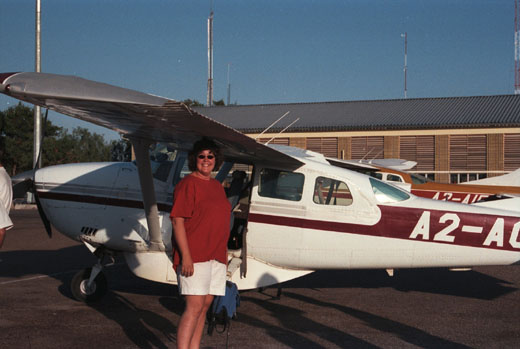
Oh, did I mention that because we’ll be travelling between countries in small bush planes like this one, our baggage is restricted to one 15 kg. duffel bag and a small carry-on bag each? For a whole month of travel! I took more than that on my last trip to Toronto, and it was just for a weekend. Thank goodness for the new lightweight microfibre fabrics.

I just have one question: if it turns out that Tilley Endurables’ advertising is wrong and it you can’t actually travel around the world on 2 pairs of their underwear, do you think they'll make deliveries to bush camps?

Saturday, August 23, 2008

From Africa with Love


As many of you know, Eleanor and I are soon leaving on our long anticipated safari to southern and central Africa. We will be gone from September 7th to October 5th. And as we rush to finalize the many necessary details, our blood is starting to rush as we become pumped up and realize that what was a seeming fantasy nearly a year ago is now almost a reality.


There are any variety of questions which we have confronted and asked ourselves, least of which is: Why Africa? There is probably no simple answer to that question, especially as we read the headlines of our daily newspapers. Perhaps the most obvious response would be something like : Because it is there. Or, it is a unique tourist experience.

During the 19th century Africa was a magnet for European explorers, a type of El Dorado like the New World. More than anything else, what initially drove European exploration of the so-called "Dark Continent" was the desire to trace Africa’s river system, especially that which fed into the Nile; this assumed a mystique similar to the Northwest Passage. In reality though, the so-called "Dark Continent" was not like that for its native inhabitants, but was perceived that way only by European adventurers and colonialists.
Another answer to why we are going to Africa would be that we are seeking a return to the "simple life". Yet as tourists, we will experience anything but a " simple life". Indeed, being on safari, we are an elite of pampered and spoiled white middle-class tourists enjoying champagne breakfasts, gourmet picnic lunches, having "Sundowners " on some of Africa’s most picturesque rivers, and enjoying the sunset on the savannah as we watch the Big Five. This highly sheltered experience hardly allows us to see, no less understand, the grim economic and social African reality around us, ranging from rampant unemployment, a total lack of infrastructure, raging civil wars claiming 200, 000 to 3. 3 million dead, to vampire-like leaders and corruption at all levels.
And in that sense, it is necessary, indeed critical, to remember that the Africa around us is very much the product of European map-makers and colonial administrators. Two historical facts might put African history, and its interaction with so-called Western "civilization" , into perspective.

First , economic demographers have established that in the 18th and 19th centuries, in the order of 12 million black inhabitants from western Africa were shipped as slaves to Brazilian and American plantations, as well as to Arab sultanates; there was an estimated 15 per cent mortality rate on transatlantic slaving.
Second, King Leopold II of Belgium, who personally owned the Belgium Congo, killed over 10 million native inhabitants in his drive for profits from ivory and rubber in the period prior to WW I. This is more than the total number of Jews killed during WW II and 12 times the number of people killed during the recent Rwanda genocide.

By these standards, Karen Blixen, author of "Out of Africa", notwithstanding her liberated life style, who outright stole 1,000 acres of tribal lands from the Kenyan Kikuyu natives (who would later lead the Mau Mau rebellion against the British in 1950) for her coffee plantation was a piker.

Within this context, it probably fair to say that we feel extremely schizophrenic, bifurcated, awkward and highly fortunate that we have this once -in-a-life opportunity to observe what is reputed to be among the world’s finest scenery and most unique animal life, including the Big Five, before it is destroyed by our so-called "civilization". Only a cynic or an existentialist would ask : Who are the real animals, and who should really be kept on reserves?
We will do our best to keep you informed of our adventures the best that we can. This however, is largely dependent on our access to the internet; we already know, for example, that we will be unable to communicate to the outside while we are in Botswana and Namibia (10 days total). But we will do our best to let you know of our wanderings, thoughts and impressions in occasional bullet-like factoids and "opinionoids", and hopefully, if the technology doesn't defeat us, some on-site pics.


Meanwhile, here's a map showing our proposed route,starting in Johannesburg and travelling counter-clockwise from South Africa to Zimbabwe (just long enough to see Victoria Falls), then on to Botswana and Namibia and finally back to Cape Town, South Africa.


Richard

Monday, August 4, 2008

Preparation part 2

BR (Before Richard), I thought I knew how to prepare for a holiday:

- book the trip
- shop for the appropriate wardrobe
- shop for a suitcase large enough to hold the new wardrobe
- pack
- buy a guidebook at the airport to read en route

Turns out that all these years I’ve been missing some crucial steps. Apparently, beginning several months before departure, one must make lists. Many, many lists: lists about meds, shots, clothes, passports, camera equipment, and cancelling the newspaper; lists about things to see and things to do and things to avoid when we get there; lists for the person looking after the cat and the one watering the plants; and, of course, lists prioritizing all the other lists.

One must also buy, read, and highlight the important passages in every book one can find on the history, politics, art, religion, and economic development of every town, village, national park and truck stop one intends to visit. Then one prepares a briefing volume for each member of the travel party, containing notes on these books, along with detailed maps, the location and hours of operation of all art galleries and museums within a 100 mile radius of all hotels they’re booked into, health warnings, and a minute-by-minute trip itinerary.

Hey! I don’t mind. It keeps Richard busy while I’m out shopping, and the finished product looks pretty impressive. But this week when I received my own personal Africa briefing duotang, it came as a shock that it contained NOTHING that a traveller really needs to know.

It listed our itinerary and described the safaris, the animals we’ll be seeing and the tours we’ll be taking, and it lists all of our hotels, with phone numbers, addresses, number of rooms, and all of that nonsense, but did it mention the important details a traveller needs to know? How close are we going to be to shopping and restaurants? Is there a swimming pool? A sauna? Does the room have a bathtub or a shower? A hair dryer? A coffee maker? Room service? Little bottles of shampoo, conditioner, and hand cream? NOTHING was mentioned about any of those things! Did it mention how far I’d have to go for a chocolate fix? Did it list the good places to eat nearby? Did it describe the local food specialties and crafts? Did it talk about local markets and shopping areas? Did it tell what the locals do for entertainment? NO!

So now I have to put my shopping plans on hold before I’ve even maxed out my Visa, so that I can check out each of the hotel websites and then look them up on Trip Advisor and find out the answers to all these questions. Luckily, my briefing notes will be no more than a couple of pages, so I can slip them into my duotang and at least one of us will be fully prepared for this trip!

Sigh. A woman’s work is never done.

Eleanor